


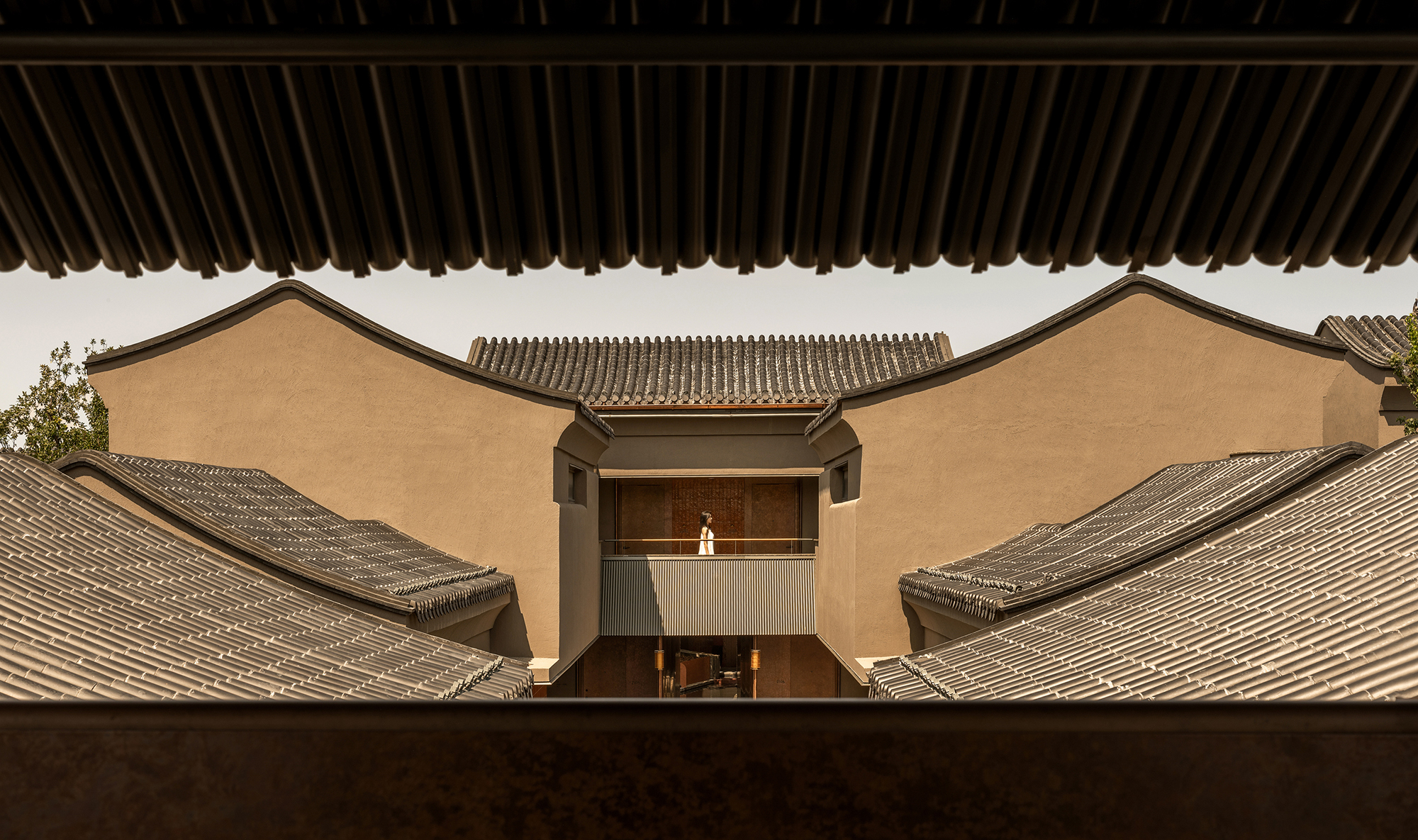
A traditional Shanxi siheyuan reimagined as a layered, five-courtyard retreat.
Set against the eastern edge of Datong’s ancient city, just beside Heyang Gate, SUNYATA Datong unfolds as a quiet extension of history rather than a standalone architectural gesture. Designed by CCD / Cheng Chung Design (HK), the project draws from the archetype of traditional Shanxi courtyard dwellings, weaving new structures into the existing urban fabric with a sensitivity that feels both deliberate and restrained.

At its core lies the spatial intelligence of Jin merchant residences—architectures defined by contrast: an imposing exterior giving way to refined, inwardly layered worlds. This duality is reinterpreted through a contemporary lens, where the familiar five-courtyard sequence is not replicated, but abstracted into a fluid spatial rhythm.

New volumes echo vernacular typologies—courtyards, narrow passageways, over-street forms—through proportion, composition and a muted material palette, allowing memory to surface without slipping into nostalgia. Across the central courtyard, restored historic houses—now guestrooms—stand in quiet dialogue with newly inserted structures, creating a measured conversation between past and present.

Underlying this architectural language is a deeper cultural reference: Pingcheng, the ancient name of Datong and former capital of the Northern Wei dynasty. The project draws from early Northern Wei sculpture, whose incised lines, abrupt turns and restrained force offer a distinct visual and emotional vocabulary. This influence is subtle yet pervasive, echoed in the tension of lines, the weight of materials, and the overall spatial discipline. References to the Yungang Grottoes, Wei stele calligraphy and Datong’s multi-ethnic heritage further anchor the project, not as literal motifs but as an atmospheric presence.

Within this framework, the interior experience unfolds through what can be understood as five spatial realms—a sequence that shapes how guests move, pause and perceive. The arrival begins with a quiet gesture: a moment of turning back towards the ancient city wall, establishing a mental threshold between present and past. The entrance itself is solid and composed, with rough stone and matte wood lending a tactile sense of time.
Inside, the lobby lounge acts as a point of release. Framed views capture the contours of the city wall and traditional rooflines, while the central courtyard mediates a subtle dialogue between restored and new architecture. Light and airflow soften the space, encouraging a slower, more contemplative pace.

The narrative deepens in the restaurant, where spatial order draws from the ceremonial structure of traditional courtyard compounds and the dining culture of northern Shanxi. Rather than dramatizing heritage, the design distils it—allowing materiality, proportion and sequence to evoke a contemporary sense of ritual.

In contrast, the swimming pool turns inward. Its subdued, cavernous atmosphere recalls the spatial qualities of the Yungang Grottoes, where light moves gently across surfaces, dissolving boundaries and creating a sense of quiet detachment.

Finally, the guestrooms return to intimacy. Drawing from the logic of courtyard living, they emphasise enclosure, tactility and framed views. Windows become living compositions of light and season, while human-scaled proportions translate the inward refinement of traditional residences into a contemporary hospitality setting.


What emerges is a project that moves beyond conventional notions of luxury. Here, space is not designed to impress at first glance, but to reveal itself gradually—through movement, material and memory.


