


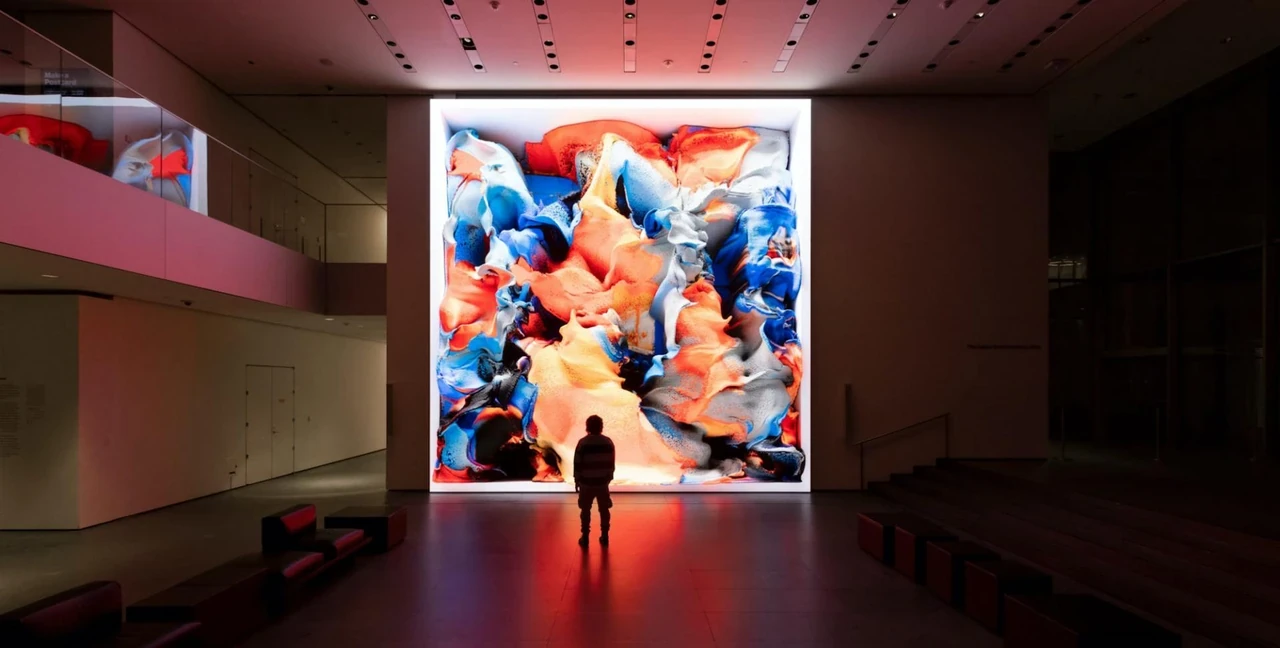
At a time when artificial intelligence is reshaping every creative field, Refik Anadol offers a more atmospheric proposition: data as pigment, machine learning as a new form of perception and architecture as a canvas in motion. Now showing at Shenzhen International Art Museum, his Machine Hallucinations: Nature Dreams invites viewers into a nature-shaped dreamscape imagined through AI.
For Refik Anadol, artificial intelligence is neither a novelty nor a shortcut. It is a way of extending perception. The Turkish-American media artist has become internationally recognised for installations that turn vast datasets into enveloping visual environments—works that ripple across museum façades, gather around viewers in darkened galleries and make architecture seem briefly unbound by gravity.
His images have the sensuous pull of abstract painting: swathes of pigment appear to melt, bloom, cloud over and dissolve. Yet their raw material is not paint, but information. Anadol’s studio works with images drawn from museum archives, urban memory and the natural world, training machine-learning models to identify patterns and unexpected relationships. These processes are then translated into constantly shifting forms. The result is less a conventional image than an evolving atmosphere—one in which viewers can feel immersed rather than simply positioned in front of a screen.
That emphasis on immersion is why architecture matters so much to his practice. Anadol does not treat a building as a blank surface waiting to be animated. Instead, he uses its scale, geometry and material character as part of the composition. A wall may appear to soften; a façade can seem to pulse or fold; a gallery becomes a place where the edges between physical structure and projected image begin to blur. Technology, in this sense, does not replace space. It gives space another register of mood, movement and memory.
His acclaimed installation Unsupervised at New York’s Museum of Modern Art offered a compelling example. Drawing on more than 200 years of MoMA’s collection material, the work continually generated luminous, abstract sequences that refused to settle into a final form. Art history was presented not as a timeline of fixed masterpieces, but as an active field of associations—restless, porous and open to new connections.
Read more: Opinion: What we’ve Learned from MoMA’s Buy of AI Art “Unsupervised”
Nature has increasingly become the focus of Anadol’s recent work. Machine Hallucinations: Nature Dreams transforms extensive datasets of natural imagery into a flowing digital environment, filled with forms that hover between the familiar and the impossible. A field of colour may evoke coral, a cloudbank or a deep forest; then it disperses before the association can settle. The experience is not a simulation of the natural world so much as an invitation to look at it afresh, through the strange and occasionally beautiful logic of a machine.

The work is now presented at Shenzhen International Art Museum in Guangming Science City, a new institution that opened in May 2026. Its appearance there gives Anadol’s work an especially timely context. In a museum conceived as a cultural meeting point for art, public life and technological change, the installation asks visitors to pause amid the acceleration of AI and consider what, precisely, is being transformed.
Video and photo courtesy of Refik Anadol


