


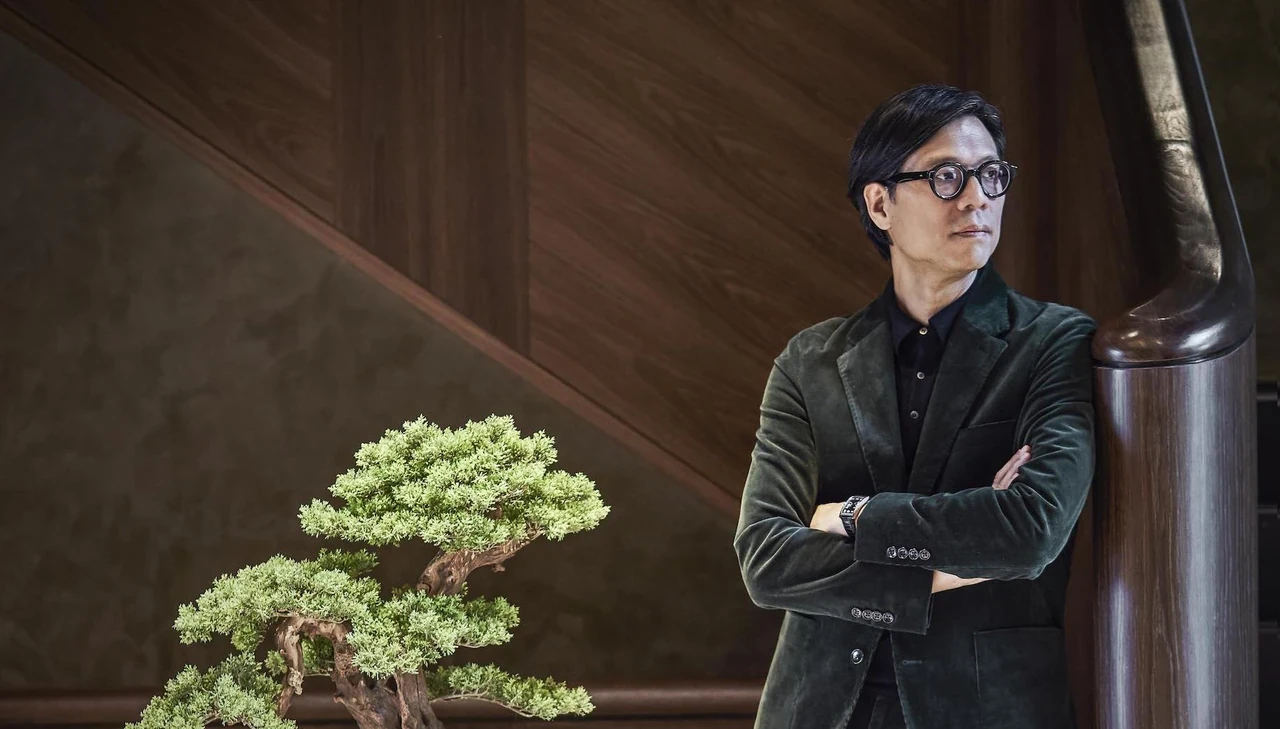
Frank Leung is the founder of via., a multidisciplinary design practice behind some of Hong Kongs most distinctive gathering spaces for bon vivants. His portfolio includes Yishè at Atrium House, House of Madison, ONE SOHO, and the WWF Peter Scott Visitor Centre, among others. This year marks the studios 15th anniversary.
Lets start with your company name. Why via.?
I wanted to keep it simple, but not make it just another alphabet company. I didnt want to use my name either because I believe a studio should transcend any individual. What were doing is actually creating a pathway. “Via” is an Italian word meaning path, and in English it means “by way of”. So, via. represents what we can achieve through design and architecture. I believe design is collaborative work – no one can do everything alone. Its collaborative not only within the studio, but also with consultants, builders, suppliers, artisans, and galleries. Im truly thankful for all of them. Theres a path were all walking together, no one walks alone.
You work across various design disciplines from private residences, lounges to show flats, and more. How do you tailor your approach to each client?
Every time we work with a client, were really creating something unique for them. Were always curious about how we can amplify a clients DNA.
Even for those who know their style very well, we still try to nudge them up another step. Take ONE SOHO for example, we used a bold salmon colour for The Roastery room, which surprised many people. For that project, I gave my interpretation of Soho, making people feel transported away from Mong Kok. The catch is, bringing a slice of Soho to the neighbourhood takes experience.
I visit NYC every year and Im fascinated by the city, its galleries, and its culture. So instead of creating a stage set feel, you can sense the authenticity there.

What did 2024 mean to you?
2024 was a time for introspection. Were looking back and identifying ways we can improve. Were currently working on a booklet for our 15th anniversary, tracking our trajectory since we started in 2009 across different project types and scales. My idea for the book, called vi5., is to summarise our projects journey – the behind-the-scenes work, sketches, models, processes, and even great ideas that havent been realised yet. Not just final products, but schemes. When I showed the draft to some of my friends, their most common response was: “How could you do this much?” Even design insiders were surprised, saying: “This is from you?” When I revisit our previous show flats, I understand some might consider them very commercial, but for us, theres so much artistic exploration happening in a show flat.
Beyond the volume of work and range, Ive also witnessed how my design language has evolved. We are placing a much greater emphasis on comfort, with a visual definition thats less cluttered, calmer, and more compact, yet spacious. Ive watched my aesthetics migrate, and seen that weve become a hardworking, prolific studio with substantial output. The process of compiling the booklet has been revealing in itself.

Which project this year has been meaningful to you?
This year we were glad to host the Open House tour at our WWF Peter Scott Visitor Centre project for the first time. While we do lots of commercial projects, our heart is also with public, civil, and educational projects. When we planned the visitor centre for WWF, it was designed as a starting point for everyone to learn about the wetland ecosystem, and as a hub for researchers and educators to stay overnight. The centre allows visitors to truly appreciate the ecosystem. Its almost like a pro bono project, designing a starting point for such important geological research.
Sometimes you finish a project and leave without knowing what happens, but this time we went back to see the operation and to hear visitor feedback. It was very meaningful to take part.
If not designing, what would you be doing?
Id be with my camera. Two things I love most about photography – first is light. Capturing light quality is something Im always drawn to.
For example, in the movie “Perfect Days” , light feels free and ephemeral – you capture that moment and itll never be the same again. Second is street life. I like things that happen just for that second and then vanish. Im always capturing moments with my phone – its like a visual journal. I dont care about polish, just capturing the moment.

Any advice for young designers today?
Its easy to start your own practice today, but its also easy to fall into the trap of wondering “Am I doing it my way, my style?” However, especially in a challenging environment, dont underestimate the importance of making your practice sustainable. Even in 2009 when we started the studio, I thought a lot about creating different income streams and maintaining return clients. When starting a business, its easy to have a certain volume of work for a while, but the question is how to grow and sustain it. Many of us designers are artistic and try to think outside the box, making us reluctant to talk business. But as my former supervisor once told me, you have to survive first, be a reliable designer, then spend time finding who you are. Getting the priorities right is very important. And one final observation I often share: these days, images are so easy, renderings are so quick, and youve got Al, but ultimately we deal with time and gravity, we deal with things that age – more real experiences never hurt.


