


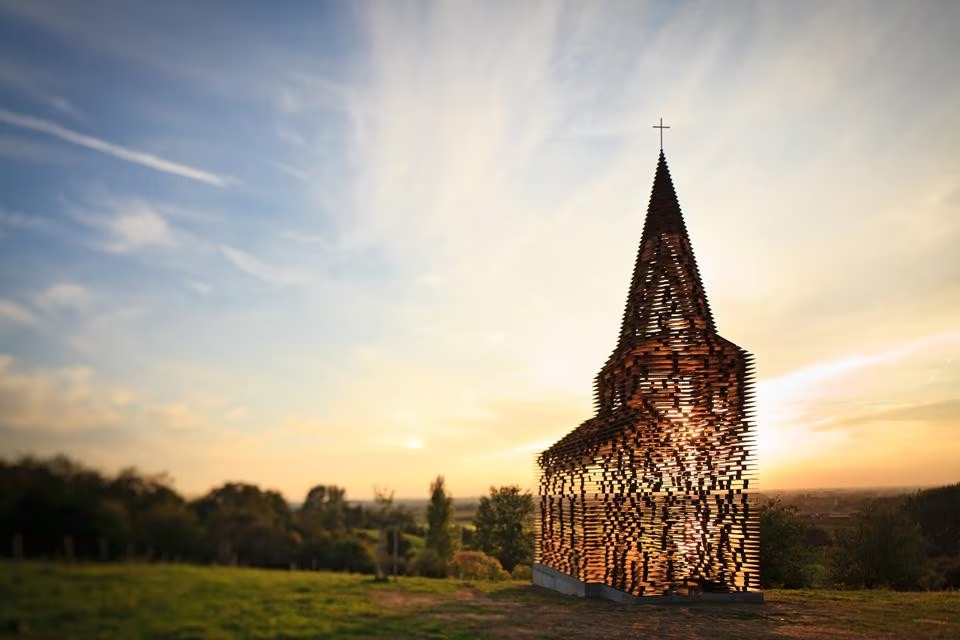
High above the fields of Borgloon, “Reading between the Lines” by Belgian duo Gijs Van Vaerenbergh looks like a solid rural church from a distance, but get closer and the whole building melts into thin air.
In the rolling hills near the village of Borgloon, a church appears to hover above the fields, its outline perfectly recognisable yet strangely weightless. “Reading between the Lines”, a permanent artwork by Belgian architectural duo Gijs Van Vaerenbergh, takes the archetype of the local parish church and dissolves it into a stack of horizontal steel slices that frame the landscape rather than seal it off.

Rising 10 metres above the ground, the structure is composed of roughly 100 layers of weathered steel plates supported by about 2,000 slender columns, collectively weighing around 30 tons. From afar, these layers compress into a solid, familiar volume, complete with pitched roof and pointed spire; move closer and the building begins to dematerialise, the gaps between plates opening up views of orchards, sky and distant church towers. It is at once present and absent, a precise object in the landscape that functions more as a lens than an enclosure.

Approaching along a rural path, the church first reads as a traditional religious structure anchoring the horizon, before shifting into a filigree of lines that allows the surroundings to bleed through. Step inside and there is no interior in the conventional sense—only an abstract play of light and shadow, where the outlines of windows, vaults and nave are suggested by overlapping profiles rather than solid walls. As the sun moves, so do the shadows, turning the space into a dynamic drawing in three dimensions.

Conceived as part of PIT, an open‑air art route coordinated by Hasselt’s Z33 house for contemporary art, the installation belongs to a broader conversation about art in public space and the evolving role of religious architecture in contemporary culture. Many European churches now stand underused, their symbolic weight far exceeding their daily function; here, the typology is distilled into an image and offered back to the landscape as a contemplative object rather than a place of prescribed worship. Visitors are free to project their own readings—spiritual, poetic, or purely aesthetic—onto the encounter, making the work less about dogma and more about perception.

For design lovers, “Reading between the Lines” is a rare fusion of architecture, sculpture and land art, one that shows how familiar forms can be reimagined to frame, rather than fight, the environment. It is a quiet yet radical gesture: a church that invites you to look not only at it, but through it, and to discover the landscape—and perhaps your own beliefs—in the space that opens between the lines.
Cover photo courtesy of Kristof Vrancken/Z33


